
Superficies land for photovoltaic parks in Romania – We specialize in identifying and purchasing land for photovoltaic parks.
Investments in Romania
We do not accept collaborations, only direct Investors!
In this article, we offer a comprehensive summary. It covers the essential legal steps for developing a photovoltaic park in Romania. We also discuss the financial steps necessary for success. We emphasize the importance of understanding local regulations and securing necessary permits. Navigating financing options is also crucial, while highlighting the potential benefits of renewable energy investments in the region.
We are a dedicated team. We have the skill and ability to comprehensively organize the premises of an energy business in Romania. We guarantee operational efficiency and compliance with local regulations. We also adhere to environmental standards. Our collaborative approach helps us maneuver through the complex energy sector. We help strategic planning and implementation. This aligns with business goals while promoting sustainable practices.
We are here! Just an e-mail away!
You have a question. You need assistance. You want to share your thoughts. Our dedicated team is always ready to help. Please reach out to us. We value every message. We are committed to providing you with the support you need. Your inquiries are important to us. We aim to respond quickly to guarantee you have a seamless experience.
Stage Zero – Initial legal structuring and land identification
Photovoltaic Energy in Romania | Renewable Energy in Romania | AgriEnergy in Romania | Lands for Solar Energy Projects in Romania | Lands for Development Solar Energy Projects in Romania | Energy in Romania | Solar Energy Projects in Romania |
1. Land selection and legal due diligence (CF, easements, restrictions).
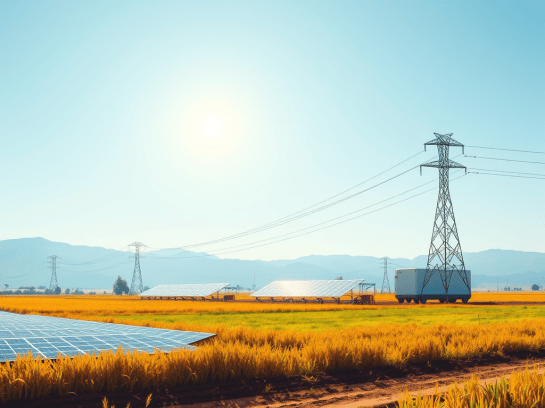
- Verification of the legal status of the land (land registry extract, easements, encumbrances, prohibitions).
- Verification of the category of use (agricultural/non-agricultural), identification of the obligation to permanently remove from the agricultural circuit (Law 18/1991).
- Identification of legal restrictions includes several elements. These are protected natural areas, Natura 2000 sites, and avifaunal corridors. They also include archaeological areas, ANIF areas, roads, and networks both underground and aboveground.
- Verification of access to the road (right of way if necessary).
- Identification of connection possibilities: distance from the distribution/transport operator’s network.
We are here! Just an e-mail away!
2. Verification of the use category and the need to remove from agricultural use.
3. Establishing the right of use: superficies area, lease, sale.
a. Superficies contract (preferred for large projects).
b. Lease contract (less bankable).
c. Transfer of right of use / Full sale.
d. Easements for cables, access, CAS, other installations.
4. Corporate structuring: SPV establishment, investment structuring.
a. Establishment of a special purpose vehicle (SPV) — LLC or SA.
b. Regulation of the relationship with the investor group (intra-group contracts, mandates, ESG policies).
Photovoltaic Energy in Romania | Renewable Energy in Romania | AgriEnergy in Romania | Lands for Solar Energy Projects in Romania | Lands for Development Solar Energy Projects in Romania | Energy in Romania | Solar Energy Projects in Romania |
Stage I – Preliminary technical documentation
1. Urban planning certificate (CU)
Central document that establishes the full list of required approvals. Includes: urban planning, environment, networks, water, ANIF, roads, defense, culture, ISU, etc.
2. Preliminary technical studies
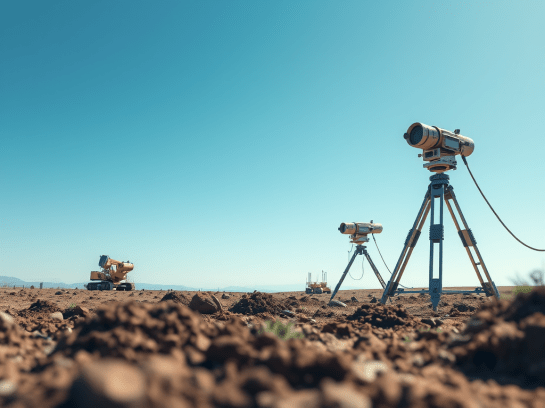
a. Topographical study + OCPI-approved topographical survey.
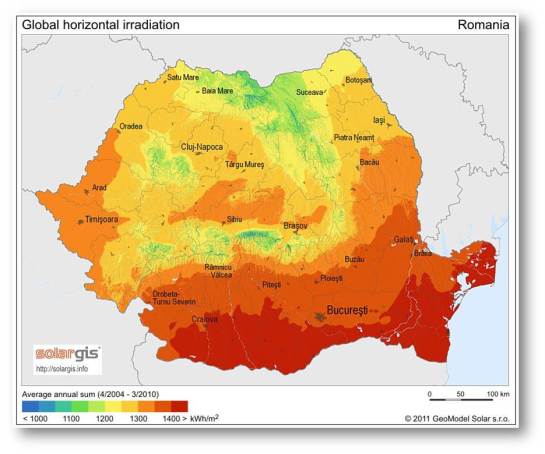
b. Geotechnical study. Study on location conditions (insolation, solar radiation).
c. Coexistence study with other utilities.
d. Energy pre-feasibility.
Photovoltaic Energy in Romania | Renewable Energy in Romania | AgriEnergy in Romania | Lands for Solar Energy Projects in Romania | Lands for Development Solar Energy Projects in Romania | Energy in Romania | Solar Energy Projects in Romania |
Stage II – Necessary approvals and agreements
We are here! Just an e-mail away!
1. Environmental procedure (EIA / Natura 2000 / classification)
a. Request for classification at the Environmental Protection Agency.
b. Possible EIA report, appropriate report (Natura 2000).
c. Issuance of the Environmental Agreement.
2. Approvals from sectoral institutions (depending on location)
a. OSD/Transportation approval (connection).
b. ANIF approval.
c. Culture and Heritage approval (if there are sites/archaeology).
d. CNAIR approval / County Roads / Communal Roads.
e. Romanian Waters approval (if there are works outside the built-up area).
f. Telecommunications, STS, Army approval (depending on the area).
g. Cadastral Office approval (for easements).
Photovoltaic Energy in Romania | Renewable Energy in Romania | AgriEnergy in Romania | Lands for Solar Energy Projects in Romania | Lands for Development Solar Energy Projects in Romania | Energy in Romania | Solar Energy Projects in Romania |
3. Technical connection approval (ATR) – critical stage
a. Submission of documentation to OSD/Transelectrica according to ANRE Order 20/2025 and 59/2013 as amended.
b. Solution study carried out by the operator.
c. Issuance of ATR with technical conditions, connection solution, distances, costs.
We are here! Just an e-mail away!
Stage III – Final removal from the agricultural circuit
Process regulated by Law 18/1991 and MARD Order.
Includes: request, ANIF opinion, removal fee, final decision.
Photovoltaic Energy in Romania | Renewable Energy in Romania | AgriEnergy in Romania | Lands for Solar Energy Projects in Romania | Lands for Development Solar Energy Projects in Romania | Energy in Romania | Solar Energy Projects in Romania |
Stage IV – Obtaining the Building Permit
Submission of DTAC and urban planning documentation, obtaining AC, ISC notification, opening of the construction site.
Stage V – Financing Structuring and Bankable Package
We are here! Just an e-mail away!
1. Financing structuring
a. Financial memorandum.
b. Bank term sheet.
c. Credit negotiation, contract facility agreement.
d. Bank guarantees: mortgages, securities, pledges on accounts, PPA/CFD receivable assignments, etc.
2. Bankability package of the project
a. EPC (Engineering Procurement Construction) — design + execution contract.
b. O&M (Operation & Maintenance).
c. PPA / Power Purchase Agreement (OTC / CfD / Corporate PPA).
d. Connection Agreement.
e. Insurance (CAR, property, liability, business interruption).
Financial Plan – Simplified Analysis
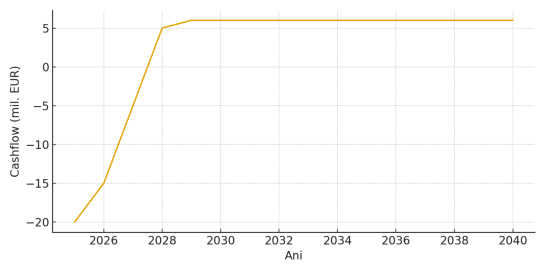
The cash flow projection presented below is a demonstration model. It includes estimated CAPEX, annual OPEX and adjusted annual production.
3. Financial analysis
a. Forecasting cash flow over a span of 20 to 30 years is vital for any business. It is also integral to an investment strategy. It enables stakeholders to predict future financial conditions. This allows them to make informed decisions. This long-term outlook involves analyzing historical cash flow patterns. It includes evaluating potential revenue streams. Various economic factors are considered. These impact financial performance, like inflation rates, market trends, and changes in consumer behavior. By meticulously projecting inflows and outflows, companies can better distribute resources. They can find funding needs. Companies will enhance their ability to manage risks. This effort supports their striving for sustainable growth and profitability in an ever-evolving financial landscape.
We are here! Just an e-mail away!
b. Sensitivity analysis is a crucial part of financial modeling. It is essential in risk assessment, particularly when evaluating investment projects in the energy sector. This involves examining how variations in key factors like energy prices affect overall project outcomes. Changes in capital expenditures (capex) and operational expenditures (OPEX) are also examined. The analysis includes observing how the weighted average cost of capital (WACC) affects the outcomes. By systematically altering these variables, stakeholders can gain insights into potential risks and returns. They can also recognize critical thresholds where project feasibility shifts. Understanding the relationships between these factors leads to more informed decision-making. It also supports better strategic planning. This process ultimately enhances the chances of successful project implementation. Additionally, it improves long-term profitability.
c. State aid structures (Measure 4.1, IPCEI, PNRR Funds, etc., if applicable) play a crucial role in facilitating economic growth and development within the European Union. These mechanisms are designed to support projects that align with specific regional priorities. They significantly contribute to the overall competitiveness of industries. They often encompass a variety of financial instruments, including grants, loans, and tax incentives, aimed at fostering innovation and sustainability. By leveraging these funds, businesses and organizations can undertake significant investments. These investments would otherwise be unattainable. This process ultimately leads to job creation and enhanced technological advancement. It is crucial for stakeholders to grasp the eligibility criteria of these aid structures. They must also comprehend the application processes to fully use their potential benefits for socioeconomic progress.
Photovoltaic Energy in Romania | Renewable Energy in Romania | AgriEnergy in Romania | Lands for Solar Energy Projects in Romania | Lands for Development Solar Energy Projects in Romania | Energy in Romania | Solar Energy Projects in Romania |
Stage VI – Project execution
1. Opening the construction site
a. The ISC notification is a critical communication tool. It guarantees that all stakeholders are promptly informed about essential updates. These updates and changes impact project timelines and safety protocols.
b. A comprehensive safety and health plan is essential. It includes a detailed assessment of potential risks. The plan outlines clear procedures for managing hazards. It mandates regular training sessions for all personnel. It provides guidelines to promote a culture of safety among the workforce.
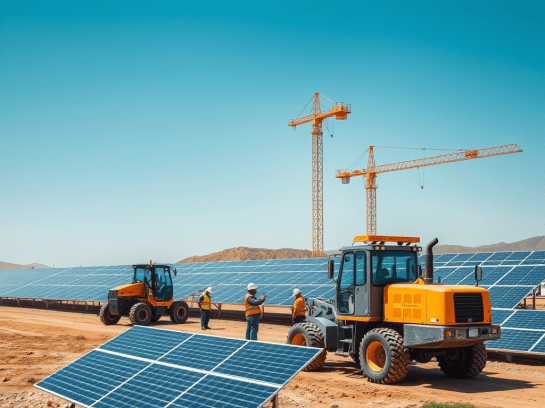
c. The site organization must focus on efficient layouts that allow smooth operations. Platforms and internal roads should be thoughtfully designed to enhance accessibility. They should guarantee the safe movement of equipment and personnel. Additionally, they must adhere to best practices in project management and environmental sustainability.
2. Construction work
a. Execution of foundations, assembly of metal structures, inverters, transformers.
b. Installation of photovoltaic panels.
c. Construction of transformer station and internal infrastructure.
3. Connection work
a. Underground cables / LEA to the connection point.
b. 20/110 kV or 33/110 kV substation as appropriate.
c. Acceptance tests and electrical tests.
Stage VII – Commissioning and ANRE licensing
1. Technical recipes and minutes
a. Reception upon completion of works.
b. ISC, ANRE, OSD checks.
c. Final energizing protocol.
2. ANRE license
a. An electricity production license is a crucial necessity for anyone looking to enter the energy sector. It ensures compliance with regulatory standards. It also promotes sustainable practices in electricity generation. Obtaining this license involves a thorough review process to verify that all operational procedures meet the necessary guidelines.
b. Registration in the market is essential for facilitating transactions. It also enables efficient market participation. This includes platforms like OPCOM, BRP, and aggregator services. Through proper registration, producers can offer their generated electricity to consumers. They can also connect with other market players. This enhances competition and drives innovation in energy solutions.
3. Commercial contracts
a. Balancing services supply contract.
b. Energy sales contracts (PZU, PCCB, PPA).
Photovoltaic Energy in Romania | Renewable Energy in Romania | AgriEnergy in Romania | Lands for Solar Energy Projects in Romania | Lands for Development Solar Energy Projects in Romania | Energy in Romania | Solar Energy Projects in Romania |
Stage VIII – Commercial Operation Data (COD)
Production monitoring, O&M maintenance, reporting, PPA management, and financial flows are critical components of an effective energy management system. Ensuring optimal performance through diligent production monitoring allows for the identification of potential issues before they escalate, thereby minimizing downtime. Regular and thorough O&M maintenance ensures that equipment operates at peak efficiency. It adheres to safety guidelines. Comprehensive reporting provides stakeholders with transparent insights into operational successes. It also identifies areas needing improvement. Effective management of Power Buying Agreements (PPAs) is essential for securing favorable terms. It fosters long-term partnerships. This management directly influences financial flows. It ensures that revenue generation is maximized and financial obligations are met promptly.
Stage IX – Decommissioning / Repowering
Decommissioning plan, land restoration, repowering choice at the end of the term.
Close collaboration between the broker, the technical expert and the legal advisor/lawyer specialized in energy law is essential. This helps to avoid bureaucratic blockages. It also ensures the long-term viability of your investment. The success of the investment depends on a solid knowledge of the necessary documentation and procedures.
Photovoltaic Energy in Romania | Renewable Energy in Romania | AgriEnergy in Romania | Lands for Solar Energy Projects in Romania | Lands for Development Solar Energy Projects in Romania | Energy in Romania | Solar Energy Projects in Romania |
Investors, as members of our community, you will have access to our skills in various fields. These include Classical Agriculture and Ecological Agriculture. We also specialize in Photovoltaic Energy in Romania and AgriEnergy in Romania.
We are here! Just an e-mail away!
Our team is dedicated to providing you with the latest insights and trends. We focus on sustainable farming practices, renewable energy solutions, and innovative agricultural technologies.
We offer a range of investment opportunities in the agriculture and energy sectors. This includes organic farming ventures, solar energy projects in Romania, and agribusiness enterprises.
Join our community today and enjoy the benefits we offer! Together we can make a difference and build a better future for everyone.
Photovoltaic Energy in Romania | Renewable Energy in Romania | Farm Land For Sale in Romania | Lands for Solar Energy Projects in Romania | Romanian Farmland For Sale | Energy in Romania | Solar Energy Projects in Romania |
Ion Tudor – Investments Consultant
Mobile: +40 734.845.159

contact@investmentsinromania.eu
Photovoltaic Energy in Romania | Renewable Energy in Romania | Farm Land For Sale in Romania | Lands for Solar Energy Projects in Romania | Romanian Farmland For Sale | Energy in Romania | Solar Energy Projects in Romania |
Proposals for investments in Romania
We can propose land for the development and construction of wind and photovoltaic parks.
We can propose agricultural farms suitable for Agrienergy in Romania.
We have vast experience in the field of land acquisition. This allows us to find and offer you with suitable land for your solar energy and wind projects. We guarantee strict compliance with the Romanian legislation in force.
Our lands are strategically located. They are close to the high voltage grids. These include LEA 110 KV, LEA 220 KV, or LEA 400 KV. This location ensures you have easy access to the infrastructure necessary for the efficient operation of your projects.
We can help you with the introduction of the offer. We also help with the facilitation of site visits. We manage preparatory aspects and negotiations between owner and investor.
We have skill in negotiating the financial and legal terms. This allows us to offer consultancy services in forming and cementing the relationship between owner and investor. The end result is the signing of the contract with right of superficies.
We will simplify the process of obtaining the necessary documents for the real estate deal. We will make sure that all legal procedures are carefully followed. Our goal is to keep a transparent and compliant process.
I have made this summary. This will help you understand that I am a Trusted Partner. In reply, I look ahead to Your Answer.
We are here! Just an e-mail away!

- Investments in Romania
- Stage Zero – Initial legal structuring and land identification
- 1. Land selection and legal due diligence (CF, easements, restrictions).
- We are here! Just an e-mail away!
- 2. Verification of the use category and the need to remove from agricultural use.
- 3. Establishing the right of use: superficies area, lease, sale.
- 4. Corporate structuring: SPV establishment, investment structuring.
- Stage I – Preliminary technical documentation
- Stage II – Necessary approvals and agreements
- Stage III – Final removal from the agricultural circuit
- Stage IV – Obtaining the Building Permit
- Stage V – Financing Structuring and Bankable Package
- Stage VII – Commissioning and ANRE licensing
- Stage VIII – Commercial Operation Data (COD)
- Stage IX – Decommissioning / Repowering
- Proposals for investments in Romania
