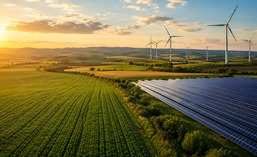
Romania offers a broad range of agricultural and renewable-energy opportunities, but a local opportunity is not automatically an investable asset. The difference lies in the work between first access and investment decision: identifying the right opportunity, testing the underlying facts, securing the relevant rights, coordinating local workstreams and presenting the result in a form that an investor can assess.
For Tudor Business Investments, this is the core of origination and execution. The objective is not to assemble a catalogue of disconnected assets. It is to build a selected, traceable pipeline aligned with a defined investment mandate.
The gap between local access and investment readiness
Many opportunities begin locally: a landowner considering a transaction, an operating farm that may suit a larger agricultural strategy, a potential solar or wind site, or a land position that could support a battery-storage or hybrid-energy concept.
At that stage, the opportunity may still be incomplete from an investor’s perspective. Ownership may need to be verified. Cadastral status may be fragmented. Access corridors may be unclear. Critical parcels may not yet be secured. The permitted use, development context or transaction pathway may still require work.
This is why the first useful question is not simply “What is for sale?” The more important questions are: what sector is the investor targeting, at what scale, in which region, at what development stage, within what timetable, and with what acceptable risk profile?
Only after that mandate is clear does origination become selective rather than opportunistic.
Origination begins with the mandate
A defined mandate creates a filter. It allows opportunities to be screened against practical requirements rather than headline descriptions.
In agriculture, the relevant factors may include freehold land, leasehold structure, consolidation, irrigation, storage, operating infrastructure and the route to acquisition or long-term ownership. In renewable energy, the focus may shift toward land control, turbine or solar positions, access corridors, surface-right structures, development context and the relationship between land and energy infrastructure.
The principle is the same in both sectors: an opportunity should be shaped around the investor’s decision criteria, not the other way around.
For current agricultural opportunities, see Agricultural Investment Opportunities in Romania. For the broader platform, see Tudor Business Investments — The Firm.
Five workstreams from origination to investor-ready execution
The transition from local access to investment readiness can be understood through five practical workstreams.
1. Originate
The first task is to identify landowners, agricultural assets and renewable-energy opportunities that fit the defined mandate. This is not only a sourcing exercise. It requires understanding whether the opportunity can plausibly match the investor’s sector, scale, location and timing requirements.
2. Screen
Initial screening focuses on the facts that determine whether further work is justified: ownership, cadastral status, access, restrictions, critical parcels and the broader development context.
At this stage, the objective is not to eliminate every risk. It is to distinguish between issues that can be resolved through execution and issues that are structural enough to change the investment case.
3. Secure
Where the opportunity passes screening, the next stage is to coordinate the structures that create practical site control. Depending on the asset, this may include land aggregation, owner engagement, access corridors, superficies or other relevant surface-right arrangements.
For renewable-energy investors and developers, site control is often the bridge between a theoretical location and a project position that can support further development. TBI’s solar and wind work is described in more detail in Solar Investments in Romania and Wind Energy in Romania.
4. De-risk
Investor readiness depends on coordination across multiple local workstreams. These can include cadastral, legal, urban-planning, permitting and stakeholder matters.
The purpose is not to create the appearance of a risk-free asset. It is to clarify the dependencies: what has been verified, what remains in progress, what can reasonably be resolved, and what residual risks should remain visible to the investor.
5. Deliver
The final step is an investor-ready hand-off: clear documentation, identified dependencies, residual risks and a defined route toward development or transaction.
That hand-off is important because sophisticated investors do not assess only the headline opportunity. They assess the quality of the information, the logic of the workstreams, the reliability of local execution and the clarity of what still needs to happen next.
Agriculture and renewable energy share the same execution problem
Agricultural assets and renewable-energy projects are different investment sectors, but the local execution challenge often has the same structure.
Both depend on the integrity of land information. Both can be affected by fragmented ownership, cadastral conditions, access and documentation. Both require a clear understanding of which rights are controlled, which rights still need to be secured and which dependencies sit outside the immediate transaction.
This is also where agriculture and energy can intersect. Land may have agricultural value today while also carrying strategic optionality for solar, wind, battery storage or hybrid infrastructure. The relevant question is not whether every asset should be converted into an energy project, but whether its long-term use and investment logic have been properly understood.
That intersection is reflected in TBI’s AgriEnergy strategy in Romania.
From a list of opportunities to a traceable pipeline
The institutional value of origination is not measured by the number of opportunities presented. It is measured by the quality of selection and the ability to trace how an opportunity moved from first access through screening and control toward a decision-ready position.
This requires discipline. Some opportunities should stop at screening. Others justify further land work. A smaller number may progress toward transaction or development. The pipeline therefore becomes more selective as work advances.
That is preferable to presenting investors with a large inventory of unrelated listings where ownership, access, development context and execution dependencies remain unclear.
Selective and confidential access
Institutional origination also requires disciplined disclosure. Sensitive information — including owner identity, precise location, cadastral documentation and transaction details — is not always appropriate for public distribution.
TBI therefore works selectively with qualified counterparties and discloses sensitive information progressively, where appropriate under confidentiality arrangements. Availability, scale and asset status are verified for each mandate before detailed information is released.
The platform is designed to work with international investors, infrastructure and private-capital platforms, renewable-energy developers and IPPs, utilities and strategic operators, as well as agricultural investors and operating partners.
Execution is part of the investment thesis
In Romania, the difference between an interesting local opportunity and an investor-ready asset is often determined by execution before the investment committee ever sees the file.
Origination establishes access. Screening tests the opportunity. Site control creates practical substance. De-risking clarifies what remains. Delivery turns the accumulated work into a decision framework.
For investors entering or expanding in Romania, that sequence matters because the quality of local execution directly affects the quality of the opportunity that ultimately reaches them.
Tudor Business Investments is a Romania-focused origination and execution platform working across agricultural assets, solar, wind, BESS and hybrid opportunities, land origination and site control.
Contact: contact@investmentsinromania.eu
This article is for introductory and informational purposes only. It does not constitute an investment offer or legal, tax or financial advice.
You must be logged in to post a comment.